thought about

Marrakech, Morocco

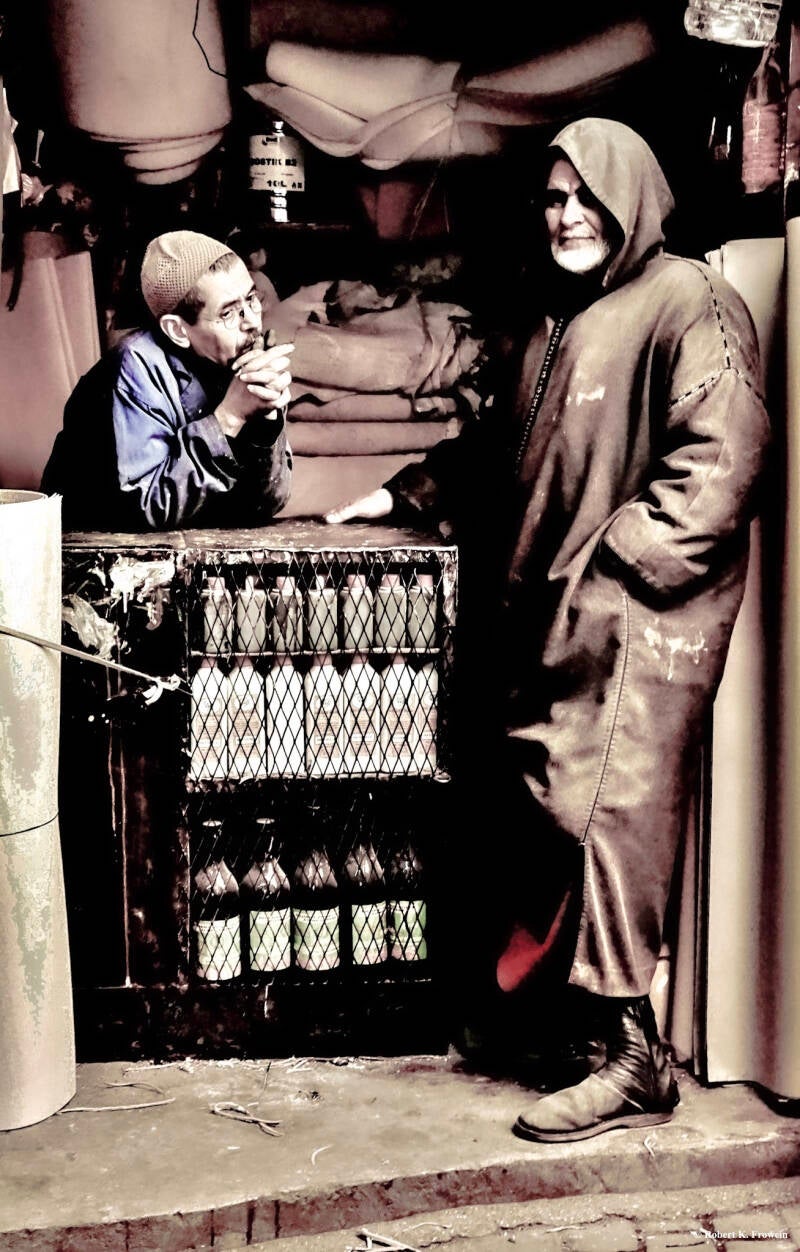
thought about happened in the souks of Marrakech, Morocco. Along the narrow alleys, countless traders operate shops to offer their wares for sale. Many people come there - locals to do their shopping, tourists to marvel at the hustle and bustle and to pick up more or less authentic souvenirs.

Amidst the hustle and bustle, however, there are always opportunities to find peace. thought about shows two men in conversation, yet silent, facing each other. Their faces are thoughtful, calm, almost rapt, yet very present. The composition is accidental, yet rich in nuances that seem perfectly arranged: the drapery of the blue smock, as well as the brown coat, the dark shoes, interspersed with the strict graphic of bottles behind bars and the soft lines of the fabric bales in the background, accented by the red trim at the bottom of the brown coat.

thought about lets the viewer immerse themselves in the vibrant world of the souks, in a moment of calm and contemplation.


passing by

Marrakech, Morocco

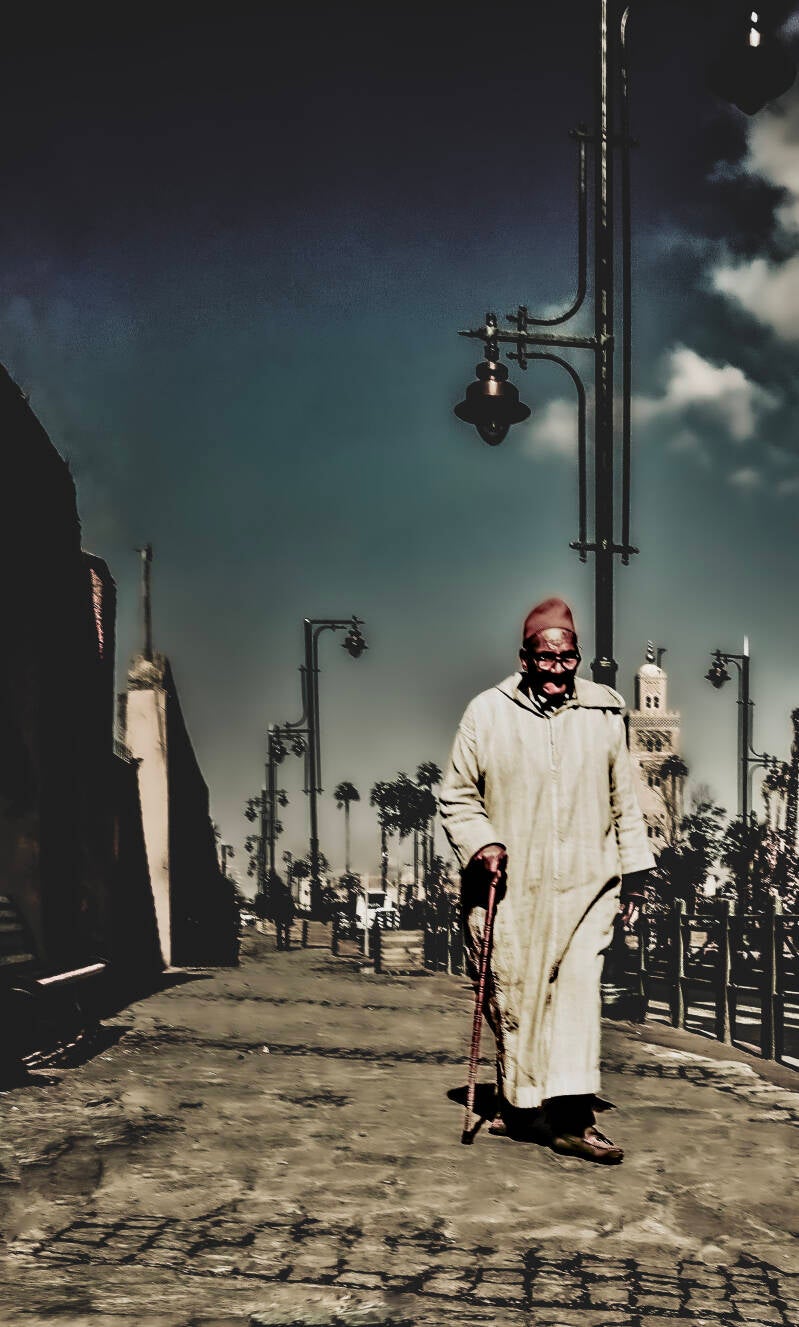
passing by happened near Djemaa el Fna in Marrakech - the central square of the Medina, the old city. In the background we see the minaret of the great Koutoubia Mosque.

An older man with a walking stick may be coming from a mosque visit, now going home or to his salon de thé to meet friends and discuss the day's events. He is wearing the typical Moroccan attire - the djellaba, a long, loose-fitting garment with a pointed hood, and on his head a red cap, called a Fez or Tarboosh.

The shot was taken in passing by, "shot from the hip," with the camera not at eye level, but precisely at the right moment when the man's movement seems to correspond with the mosque tower and the ornate lampposts. The unusual perspective, the slight motion blur, and the tilted axis create an image of passing byness that invites us to focus better on the fleeting moment.


spice square

Marrakech, Morocco

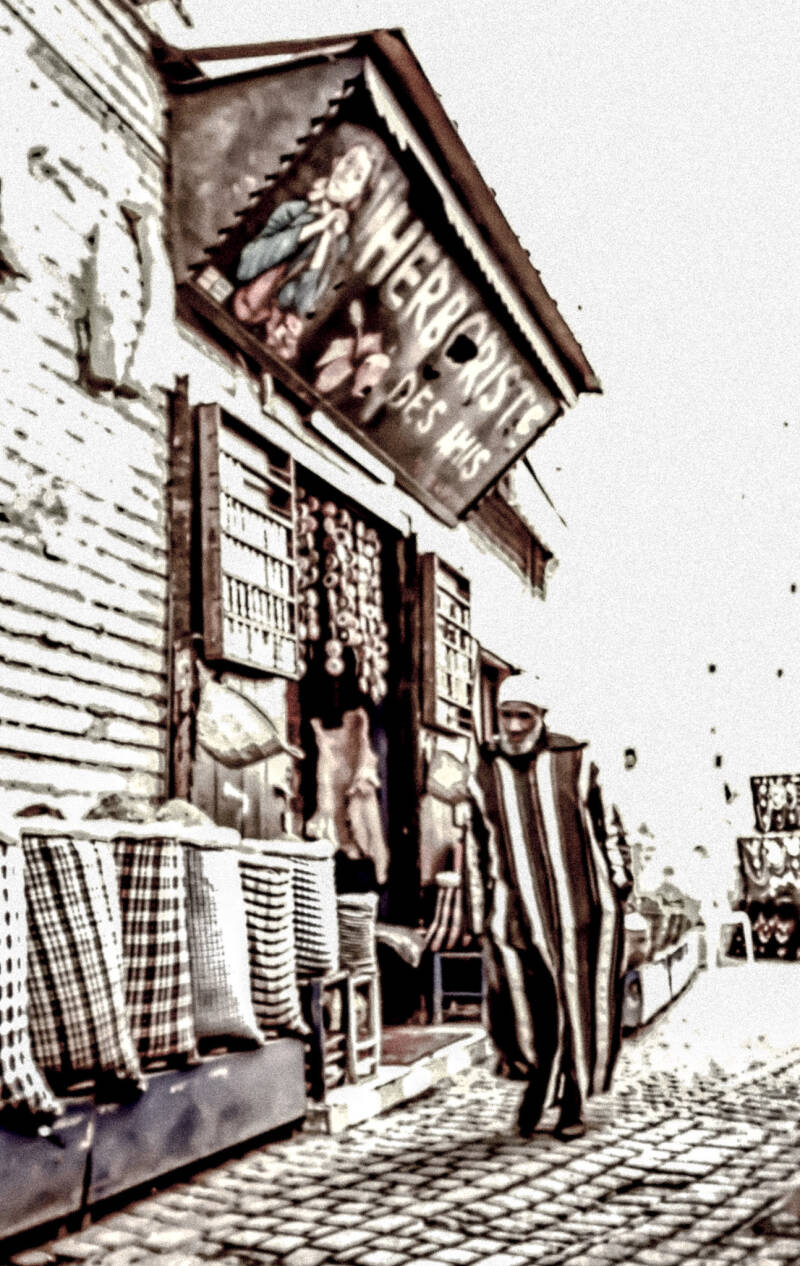
spice square originated in the souks of Marrakech, Morocco. The souks are a labyrinth of narrow alleyways and small squares where countless traders offer their goods – particularly products of Moroccan craftsmanship and food. The many spice merchants usually display their wares in large, open bags – to showcase the vibrant colors and intense aromas which can be scented all around.

spice square depicts a spice merchant – Herboniste des amis – in one of the small squares between the alleyways. The image is blurry and overexposed, so few details are discernible. However, the graphics and composition of the image are exceptional: The lines of the house wall, the cobblestones, the spice bags, even the jellaba of the passing man seem to interact, challenge, and complement each other. The strict geometry and monochrome color scheme are accented here and there by barely recognizable garlic cloves and specks of color on the sign above the shop entrance.


sand horizon

Giza, Egypt

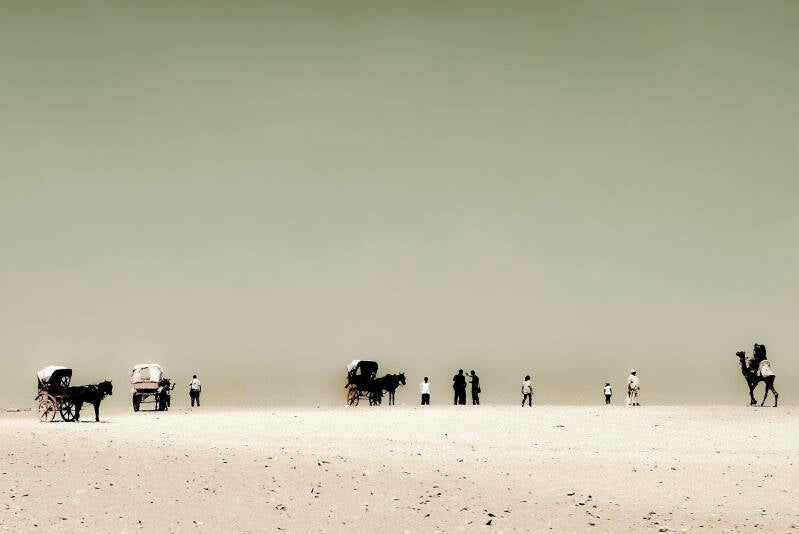
sand horizon happened in Giza, Egypt, near the pyramids, on a hot summer morning. Tour guides are waiting for prey - tourists to whom they can show the area for a reasonable fee, either with their donkey carts or on the back of a camel. On this particular morning, demand, at least at this spot, is still limited. Thus, they make for an attractive subject for the photographer.

sand horizon is conceived minimally: the sandy ground, brightly illuminated, barely distinguishes from the whitish light of the sky. Along the horizon line, various figures  - people, animals, donkey carts - are discernible in outlines and reduced coloration. The viewer can feel the day's heat, as well as the sluggishness that has already settled over humans and animals. Whether the picturesque donkey carts invite a ride is not yet decided—they are certainly not comfortable or spacious, but at least they promise to provide some shade and save the weary tourist their own kinetic energy.


giza morning

Giza, Egypt

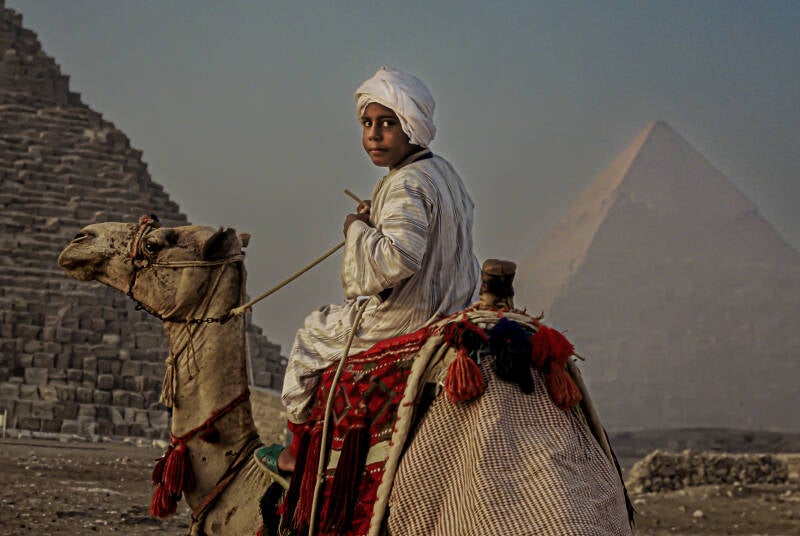
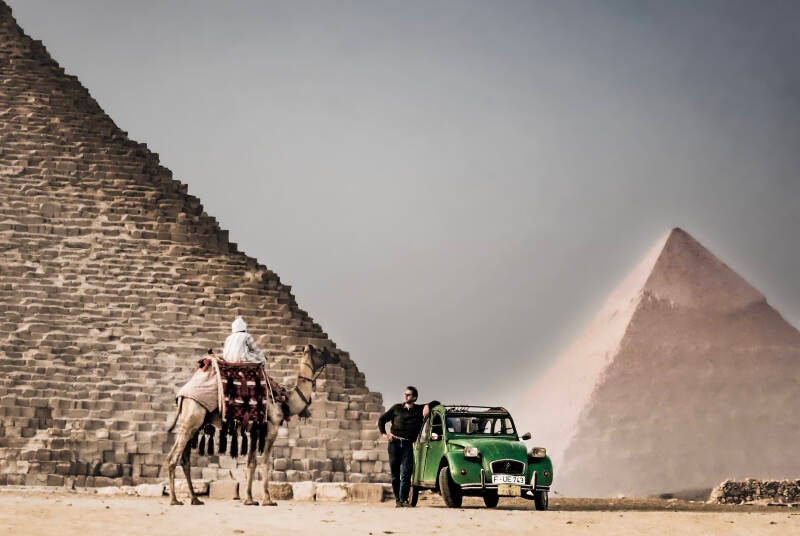
giza morning happened near the Pyramids of Giza in Egypt on an early morning in September 1989. At the early hour no tourists were yet to be seen, although they are normally gathered here in large numbers.

The photographer, then a student, had traveled from Germany with his best friend in their trusty travel vehicle, a Citroën 2CV. It may seem surprising nowadays, but this very car is especially well suited to this rather unusual kind of long-distance journey: it is inexpensive to acquire, spacious, comfortably sprung, very economical on fuel, sufficiently reliable, otherwise easy to repair. And it has a roll-back roof, which on the one hand invites leisurely open-air driving, and on the other is ideally suited for hanging freshly washed shirts out to dry in the sun and fresh air — clearly visible in the picture.

The “Ente,” german for duck and called so by enthusiasts, is perfectly positioned in the image right at the foot of the converging side lines of the pyramids. The pyramid in the background is clearly identifiable as the largest of the Giza pyramids, Khufu’s Pyramid. Beside the "Ente" is parked a camel with its rider, who presumably is waiting for the influx of tourists eager to experience the adventure of sitting on a camel. Thus, a whole animal world meets here among the pharaohs. Camel rider and Ente driver greet one another and, one may imagine, exchange experiences about their vehicles and the day journeys ahead of them.

The viewer is presented with a colorful range of further stories to imagine: how did the Ente get there, where would it go next? What might the camel rider have thought in the face of this almost extraterrestrial encounter, and what later told his friends? How does one even get such strange idea to drive to Egypt in an Ente?